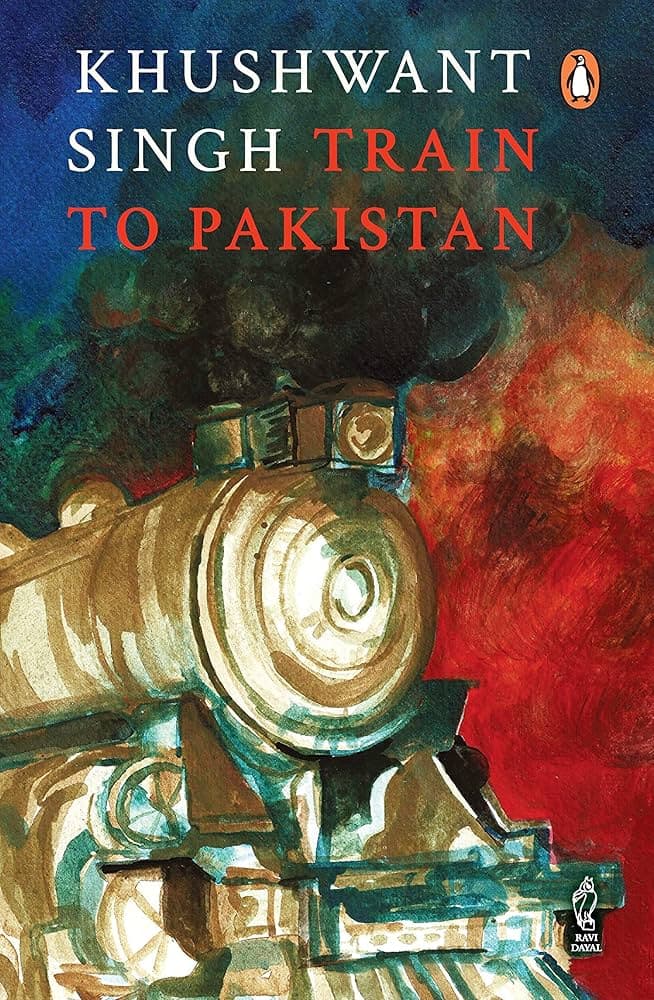
Personal Take
masterpiece at home
This was my very first dive into partition literature and I am officially, completely obsessed. Khushwant Singh really did something insane with this book. The writing style is so simple to read, yet it punches you straight in the gut. You literally feel everything the characters are going through. The pure panic, the hate, the overwhelming anxiety, and the nervousness of that era are so incredibly vivid. And oh my god, the love story at the very end completely stole my whole heart. It is just so damn good. You need to read this immediately.
- Narratology
- Postcolonialism
- Intertextuality
- Patriarchal constructs
Academic Review (spoilers)
Academic Review for Train to Pakistan
Khushwant Singh’s Train to Pakistan has long outgrown its initial reputation as a simple historical record of the 1947 partition. Modern scholarship treats the text as a complex site for theoretical investigation. By moving beyond the surface level trauma, researchers use diverse frameworks to analyze how the novel maps out the socio-cultural realities of a fractured subcontinent.
Structural Integrity and Polyphonic Narratology
The architecture of the novel is explicitly divided into four distinct segments: "Dacoity, Kalyug, Mano Majra, and Karma." Scholars frequently debate whether this rigid structural division successfully contains the chaotic reality of partition. A major point of contention is the true identity of the protagonist. Many critics argue that individual characters are secondary to the collective space, positioning the village of Mano Majra itself as the principal protagonist (Omprakash 3).
However, this structural setup reveals deep imbalances. The character of Iqbal is widely criticized as a major structural weakness. Critics note that Iqbal lacks flesh and blood, acting instead as an awkward interpolation dictated by non-textual considerations (Omprakash 5). He functions more as a mouthpiece for Singh’s personal intellectual dilemmas regarding social change than as a fully realized human being.
To counter these structural critiques, recent studies apply Gerard Genette’s theory of narratology to reframe the text. Scholars argue that the novel employs a polyphonic structure where multiple distinct voices coexist and interact (Sabeen et al. 568). This narrative design enriches the reader’s engagement, forcing us to confront historical trauma from several conflicting angles rather than a single authoritative perspective.
Feminism, Motherhood, and the Honor Critique
Feminist critiques of Train to Pakistan focus heavily on how the text handles gender, showing that the narrative frequently reproduces traditional patriarchal constructs. Women in the novel are largely presented in weak, submissive roles and are objectified with little genuine agency of their own (Sabeen et al. 572). The female characters are confined to a strict binary representation: they are cast either as the prostitute, represented by Haseena Begum, or as the modest woman, represented by Nooran.
Despite these limitations, critics find deep symbolic meaning in how motherhood is framed. Nooran’s pregnancy functions as a powerful metaphor for the birth of a new Muslim nation in the form of Pakistan. Yet, this metaphor is intentionally messy. Because her child is fathered by Juggut, a Sikh, the pregnancy suggests a fundamental impurity of ethnicity (Sabeen et al. 574). This biological reality directly challenges the neat, rigid borders envisioned by nationalist politicians.
Furthermore, scholars challenge the novel’s validation of mainstream nationalist discourse regarding female honor. The text shows a troubling acceptance of the idea that heroic femininity belongs to the Sikh ladies who commit suicide to fight off potential sexual assault. This narrative pattern reinforces a damaging patriarchal system where a woman’s social death must always precede her physical death if her bodily purity is compromised.
Postcolonial Identity and Internalized Racism
By reading the character of Juggut Singh through a postcolonial lens, researchers uncover deep anxieties regarding racial identity and internalized colonial inferiority. Juggut struggles with a severe inferiority complex, feeling deeply self-conscious about his dark skin color and black identity (Hasan 9).
When Juggut encounters the Westernized, educated Iqbal, it triggers a psychological crisis. Juggut perceives the English language as inherently superior and actively strives to learn English from Iqbal as a literal tool to diminish his own blackness (Hasan 11). This dynamic mirrors Frantz Fanon’s postcolonial theories, which explain how the colonized subject is forced into an internalization of the self as an "other." Juggut’s internalized racism is projected outward when he describes local women as "black buffaloes" while contrasting them against the "white and soft" European memsahibs (Hasan 12). His language shows just how deeply colonial hierarchies of beauty and worth were absorbed by ordinary individuals.
Musicality, Folk Culture, and Intertextuality
The inclusion of songs, poetry, and local cultural practices is not just decorative; it serves as a vital tool for establishing cultural authenticity. Singh uses these elements to inject a variety of viewpoints, nuances, and aesthetic qualities into an otherwise bleak landscape (Sabeen et al. 576).
The text relies heavily on literary intertextuality through frequent references to classical poets like Mirza Ghalib and Faiz Ahmed Faiz. These poetic interruptions deepen the emotional resonance of the narrative, giving intellectual depth to Iqbal's internal isolation. Similarly, the inclusion of Punjabi folk songs and Haseena’s musical performances for the Magistrate, Hukum Chand, subverts traditional power dynamics. Haseena’s song, which explicitly speaks of a lover being "done to death," functions as a dark piece of dramatic irony (Sabeen et al. 578). The music underscores the heavy atmosphere of suffocation and death surrounding the Magistrate’s corrupt personal life, proving that folk culture acts as a commentary on political moral decay.
Bibliography
Hasan, Mahmud Al. "Exploring Decolonization and Colonial Legacies: A Postcolonial Reading of Khushwant Singh’s Novel Train to Pakistan." Shanlax International Journal of English, vol. 12, no. 3, 2024, pp. 7-16.
Omprakash, S. "Portrayal of (Satirical) Characters in Khushwant Singh’s Train to Pakistan." Pune Research: An International Journal in English, vol. 1, no. 3, 2015, pp. 1-6.
Sabeen, Rabia, et al. "Analysis of the Language used in ‘Train to Pakistan’ and its Appropriateness in Representing the Socio-Cultural Context of the Partition." International Journal of Contemporary Issues in Social Sciences, vol. 2, no. 4, 2023, pp. 565-579.