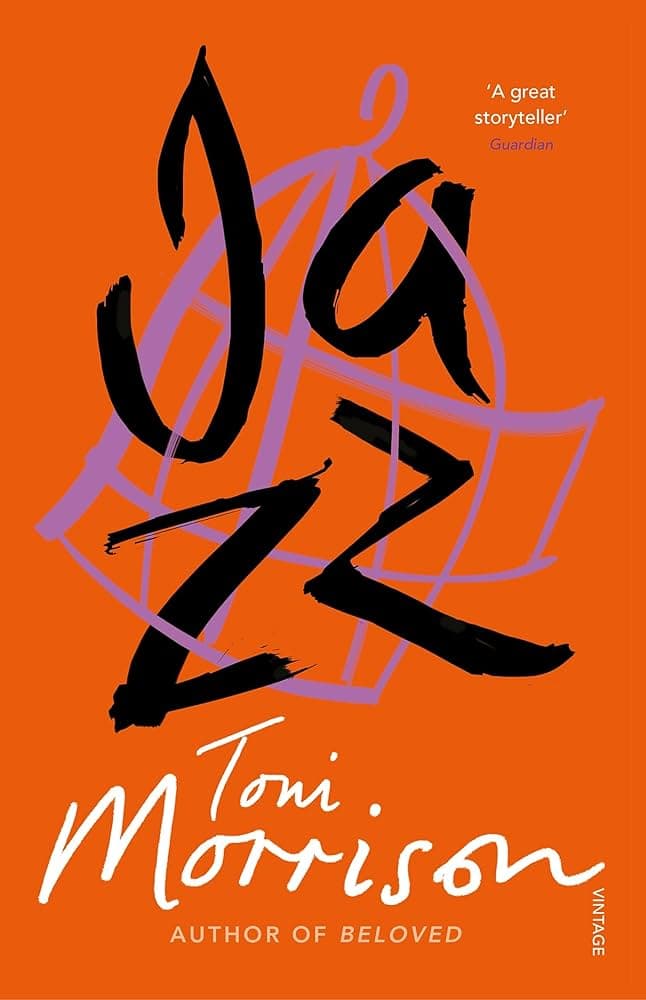
Personal Take
A mess, but make it art
This book was an absolute nightmare for me to finish. I am not lying when I say I literally DNFed this novel multiple times and it took me a whole six months to finally get through it. Morrison writes with zero chills when it comes to pauses, linkers, or normal conjunctions. The flow is so intense and deeply packed with deep cut references to Black culture that it felt like running a marathon backward. If you like straightforward storytelling, this will break your brain. But honestly, forcing myself to finish it made me appreciate the sheer chaos of how it is built. It is tough, it is exhausting, but it is also brilliant.
- Non-Linear
- Narrative Unreliability
- Intergenerational Psychic Trauma
- Modernism
Academic Review (spoilers)
Academic Review for Jazz
Structural Innovation and the Jazz Aesthetic
Toni Morrison’s Jazz is fundamentally celebrated for its revolutionary linguistic and structural resemblance to jazz music (Farshid 363). Rather than using music as a simple background theme, Morrison treats the prose as a living composition. As Nicholas F. Pici asserts, the text literally breathes the unique rhythms, sounds, and cadences of jazz music through its heavy reliance on repetition, unconventional punctuation, and internal rhyme (373, 382). Trivius Gerard Caldwell describes this narrative framework as a distinct "Jazzthetic strategy" that deliberately oralizes fiction to break down conventional, Eurocentric literary constraints (1 to 2).
This musical superstructure is achieved through a structural design that mimics a live musical performance. The stylized chapter breaks, which are visually marked by open white space instead of traditional numbering, function exactly like transitional slurs and glides in a jazz set (Pici 389). This allows the narration to seamlessly pick up lingering motifs from the previous section to maintain a continuous textual continuum (Pici 390). By forcing the reader into an interactive musical discourse, Morrison demands that the audience actively make and remake the meaning of the text as it unfolds (Pici 387, 389).
The Hostile Narrator and Democratic Improvisation
The novel breaks traditional boundaries through its deeply unstable narrative voice. Instead of offering an omniscient, trustworthy guide, Morrison introduces a gossipy, overtly hostile voice which presents itself as omniscient but eventually breaks down under its own bias (Khaleghi 2). Martha J. Cutter argues that this specific voice possesses grand pretensions toward omniscience but is proven wrong over and over again throughout the text (70). The narrator eventually breaks the fourth wall to confess an utter failure to comprehend the true depth of the characters, stating, "I have been careless and stupid and it infuriates me to discover (again) how unreliable I am" (Morrison 220; Cutter 70).
This narrative failure is a deliberate choice that mirrors the democratic spirit of a musical ensemble. Sima Farshid explains that in a jazz performance, meaning emerges collectively because no single instrument governs the piece (365). Morrison constructs her text using the exact same egalitarian philosophy. Multiple perspectives enter, improvise, and recede so that authority is distributed across a chorus of characters rather than fixed in one dominant point of view (Khaleghi 2; Pici 374). However, some scholars argue that this improvised structure can become excessive. Farshid points out that sections like the one focusing on the minor character Golden Gray are far too long, showing how an over-reliance on an improvised quality can destabilize the narrative economy (367).
Motherhood, Intergenerational Trauma, and Urban Survival
Beneath the complex musical architecture lies a profound exploration of African American trauma and maternal absence. Scholars consistently identify a foundational lack of maternal love as the core psychic wound that drives the actions of the central protagonists (Cheng 96). Olfa Drid characterizes the central couple, Joe and Violet, as deeply damaged, motherless figures with severe psychic wounds who find themselves unable to sustain romantic love because their private cracks stem directly from childhood abandonment (252, 255). Joe Trace’s toxic obsession with the young Dorcas is a displaced search for his missing mother, Wild. His violent desire is ultimately a desperate attempt to articulate and narrate stories that might connect his broken past to his present identity (Drid 254).
Violet’s trauma is similarly tied to maternal loss. Her strict decision to remain childless is a belated trauma born from her mother Rose Dear’s tragic suicide, an event that completely sucked her sleep and convinced her that the most important thing in the world was to never never have children (Drid 255 to 256). For these characters, navigating the urban landscape of Harlem requires a tough duality. The Great Migration promised economic and cultural empowerment, making the City look like a Promised Land (Mayer 344, 347). Yet, this space remains highly decisive, requiring individuals to be welcoming and defensive at the same time (Morrison 9).
This defensive necessity manifests heavily through a gendered lens of urban survival. As Alice Manfred notes, Black women in the city are forced to become dangerous and armed, relying on speed, some poison in the leaf, the tongue, the tail, or literal weapons to protect their domestic safety from a predatory environment (Morrison 77; Drid 257).
Genre Borders and Historical Distance
The novel also positions itself at a complex crossroads regarding historical and generic definition. Some cultural critics argue that the text maintains a problematic distance from the actual socio-political movements of the 1920s. Henry Louis Gates, Jr. identifies a distinct shortcoming in the way the novel remains so near to, yet so far from, the iconic Black literary movement known as the Harlem Renaissance (Farshid 365). Rather than highlighting the intellectual, political, and artistic elite of the era, Morrison intentionally focuses on the chaotic everyday lives of common people, which some historians find limiting (Farshid 365).
Furthermore, the text challenges the rigid boundaries of what actually constitutes jazz fiction. Trivius Gerard Caldwell notes that an overdetermined definition of the jazz novel often pushes Morrison’s work to the periphery because it lacks explicit musical terminology, despite being built entirely on an intricate jazz format (1). Finally, the text captures the real historical anxieties surrounding the rise of urban music. Through characters like Alice Manfred, Morrison illustrates how the 1920s religious community deeply feared this lowdown music, viewing it as the devil's music that produced greedy, reckless words, loose and infuriating, which seduced vulnerable individuals into doing unwise, disorderly things (Pici 380 to 381).
Works Cited
Caldwell, Trivius Gerard. "Jazzthetic Technique: Oralizing Fiction and Jazz Strategies in Toni Morrison’s Jazz." Humanities, vol. 12, no. 79, 2023, pp. 1-12.
Cheng, Cheng. "An Analysis of Jazz from the Perspective of Intertextuality." Frontiers in Art Research, vol. 5, no. 15, 2023, pp. 94-98.
Cutter, Martha J. "The Story Must Go On and On: The Fantastic, Narration, and Intertextuality in Toni Morrison's Beloved and Jazz." African American Review, vol. 34, no. 1, 2000, pp. 61-75.
Drid, Olfa. "Cycles of Violence, Cycles of Trauma in Toni Morrison’s Jazz." International Journal of Humanities and Cultural Studies, vol. 2, no. 3, 2015, pp. 247-258.
Farshid, Sima. "The Composing Mode of Jazz Music in Morrison’s Jazz." Journal of African American Studies, vol. 16, 2012, pp. 363-371.
Khaleghi, Mahboobeh. "Narration and Intertextuality in Toni Morrison’s Jazz." International Journal of English and Literature, 2014, pp. 1-14.
Mayer, Sylvia. "Assessments of the Urban Experience: Toni Morrison's Jazz and T. S. Eliot's The Waste Land." Connotations, vol. 8, no. 3, 1998/99, pp. 343-356.
Morrison, Toni. Jazz. Alfred A. Knopf, 1992.
Pici, Nicholas F. "Trading Meanings: The Breath of Music in Toni Morrison's Jazz." Connotations, vol. 7, no. 3, 1997/98, pp. 372-398.